

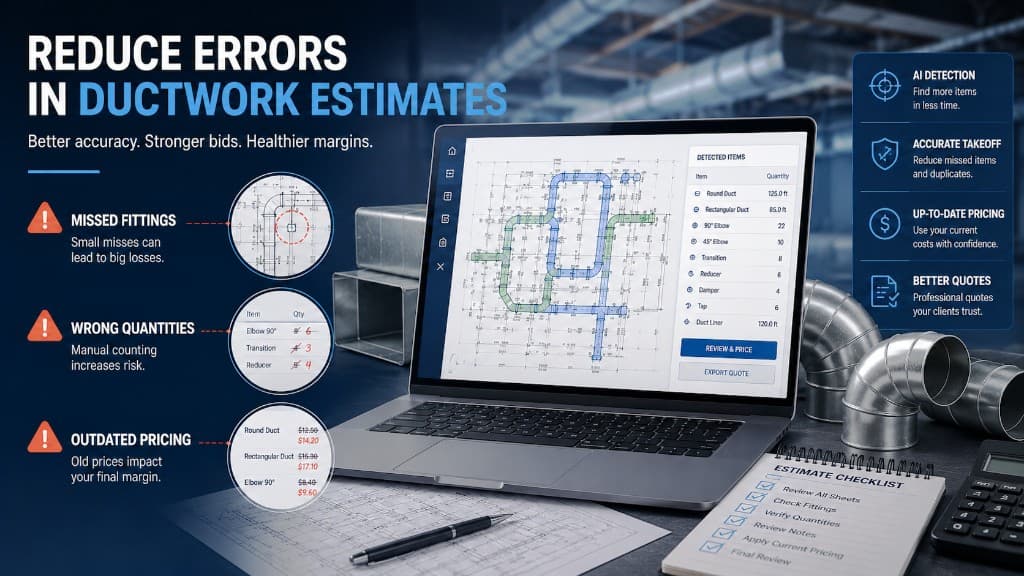
Reducing errors in ductwork estimates is one of the most important parts of protecting margin.
A missed elbow, an incorrect duct quantity, an overlooked liner note, or outdated pricing can turn a promising job into a difficult one. In HVAC and sheet metal estimating, small mistakes can become expensive when they repeat across a project.
The challenge is that estimators are often working under pressure. Bid deadlines are tight. Drawings are not always clean. Pricing changes. Revisions arrive late. The team still needs to send a professional quote on time.
A better estimating workflow can help reduce those risks.
Common Sources of Ductwork Estimating Errors
Most estimating errors are not caused by carelessness. They are caused by complexity, time pressure, and manual repetition.
Common issues include missed fittings, incorrect duct sizes, duplicate counts, outdated pricing, missing dampers, overlooked transitions, and confusion between drawing revisions.
Crowded mechanical drawings make the problem harder. When ductwork overlaps with notes, equipment, or other building systems, it becomes easier to miss small items.
Errors can also happen during data entry. An estimator may count correctly on the drawing but enter the wrong quantity into the spreadsheet. Or they may update one pricing line but forget another.
Why Manual Counting Increases Risk
Manual counting requires sustained attention.
The estimator must move through each sheet, identify each item, mark it up, count it, transfer the quantity, price it, and format it into a quote.
Every transfer point creates a chance for error.
The risk increases when the estimator is interrupted, switching between multiple bids, or working close to a deadline.
Manual takeoff can still be accurate, but it requires time and focus. When the workflow is overloaded, mistakes become more likely.
Build a More Structured Takeoff Process
The first step in reducing errors is creating a repeatable process.
Instead of treating every estimate as a new blank page, contractors should standardize the way they review plans, organize quantities, apply pricing, and prepare quotes.
A structured process should include:
- Confirming the correct drawing set
- Reviewing all relevant sheets
- Checking revision dates
- Organizing ductwork items by type
- Reviewing fittings separately
- Verifying special notes
- Applying current pricing
- Performing a final quote review
This structure reduces the chance that important steps are missed.
Use AI to Support First-Pass Detection
AI can help reduce estimating errors by supporting the first pass through the drawings.
When PDF ductwork plans are uploaded into an AI-powered estimating platform, the software can help detect visible ductwork components and fittings. This gives the estimator a starting point for review.
Instead of relying only on manual counting, the estimator can compare AI-detected items against the drawing and make corrections where needed.
This can be especially useful for fittings that are easy to miss during a rushed takeoff, such as transitions, reducers, dampers, taps, and liners.
AI should not be treated as perfect. But it can act as another layer of visibility in the takeoff process.
Keep Pricing Consistent
Quantity errors are not the only problem. Pricing inconsistencies can also affect the final bid.
If estimators use different spreadsheets or outdated pricing references, two quotes from the same company may be built differently. That creates confusion and makes it harder to protect margin.
Contractors should keep pricing organized and updated. Custom pricing should reflect the company's actual cost structure, supplier relationships, fabrication process, labor assumptions, overhead, and markup.
Sheetmetal AI supports custom pricing so contractors can apply their own pricing logic after the takeoff is reviewed.
Review Before Exporting the Quote
The final review is still one of the most important steps.
Before sending a quote, estimators should check the material list, confirm quantities, review pricing, look for missing scope items, and make sure the quote is clear.
A professional quote should be easy for the customer to understand and easy for the contractor to reference later.
When the quote is exported from a structured system, it is easier to maintain consistency across jobs.
Practical Example
Consider a commercial project with multiple drawing sheets and a tight bid deadline.
In a manual workflow, the estimator may count fittings sheet by sheet and enter them into a spreadsheet. If the estimator misses several transitions or forgets to update liner-related items, the quote may go out with incomplete quantities.
With an AI-assisted workflow, the drawings can be analyzed first, and the estimator can review a detected list of ductwork items. The estimator still checks the takeoff, but the process gives them a more organized starting point and may help catch items that would otherwise be missed.
Conclusion
Reducing errors in ductwork estimates requires more than working faster. It requires a better workflow.
Contractors can reduce risk by standardizing takeoff steps, using AI to support item detection, keeping pricing consistent, and reviewing every quote before it is sent.
Sheetmetal AI helps HVAC and sheet metal contractors upload ductwork plans, detect items, create material lists, apply custom pricing, and export professional quote PDFs.
The result is not estimating without review. It is estimating with better structure, less repetitive manual work, and more control over the final quote.
FAQ
What are common ductwork estimating errors?
Common errors include missed fittings, incorrect quantities, outdated pricing, duplicate counts, and overlooked drawing notes.
Can AI eliminate estimating errors?
No. AI can help reduce some manual risks, but human review is still required.
Why are fittings often missed?
Fittings can be small, crowded, or hidden in complex drawing areas, especially under deadline pressure.
How can contractors improve bid accuracy?
They can use structured workflows, review drawing revisions, organize pricing, and use AI-assisted takeoff as a support tool.
How does Sheetmetal AI help reduce errors?
It helps detect ductwork items, organize material lists, support review, apply custom pricing, and export professional quotes.
Reduce manual takeoff risk with Sheetmetal AI.
Review ductwork items faster before sending your next quote.
Build more consistent ductwork estimates with AI support.